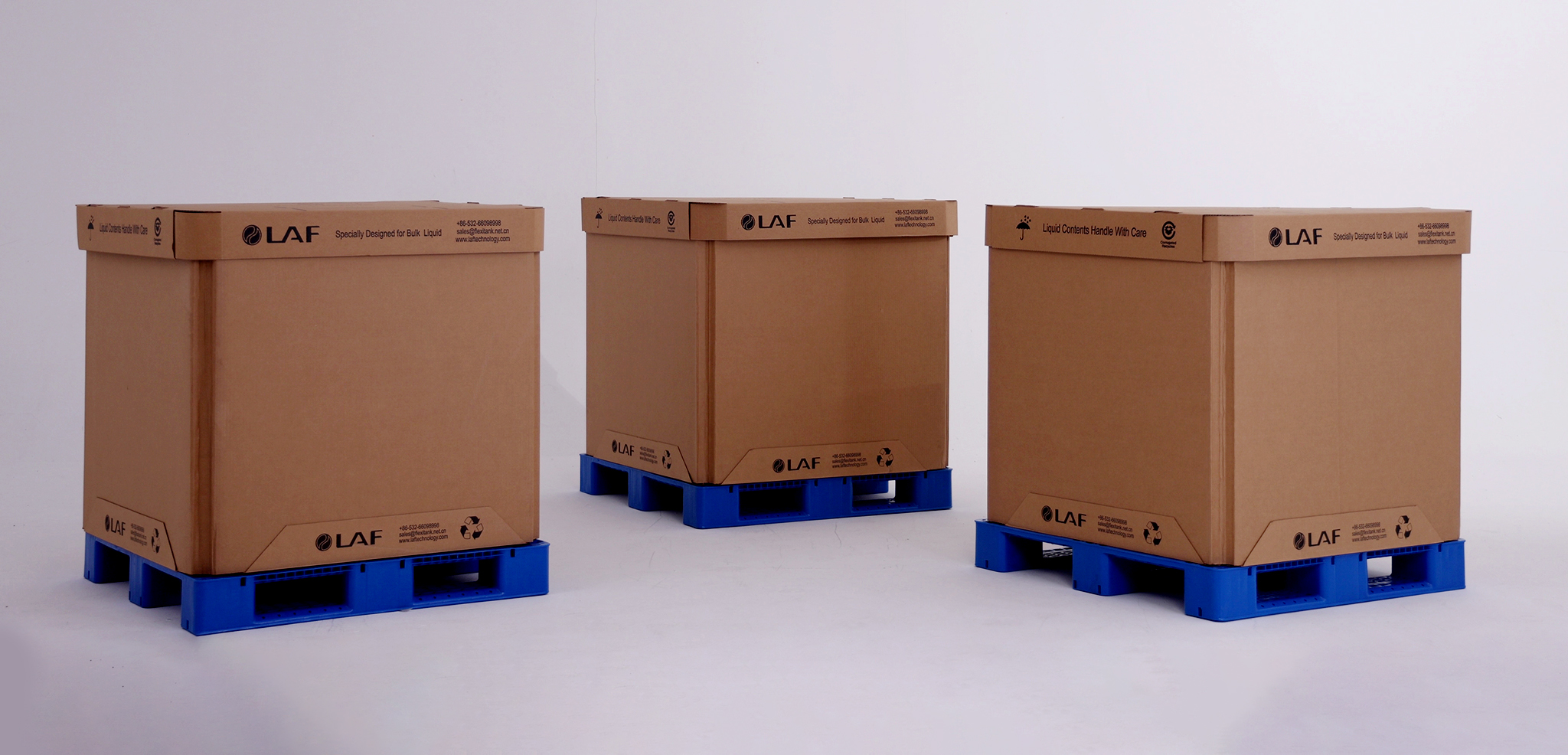
As bulk liquid transportation continues to evolve, packaging needs to do more than simply contain a product. It also needs to support efficient handling, storage, transportation, and delivery.
Paper IBC offers an alternative format for bulk liquids, combining a high-strength collapsible paper structure with an IBC liner system. With a maximum capacity of 1,200 L, LAF Paper IBC is designed to provide a practical solution for customers looking to move bulk liquids in a single packaging unit while simplifying logistics and reducing packaging-related requirements.
As bulk liquid transportation continues to evolve, packaging needs to do more than simply contain a product. It also needs to support efficient handling, storage, transportation, and delivery.
What Is a Paper IBC?
A Paper IBC is a collapsible intermediate bulk container designed for the transportation of non-hazardous bulk liquids.
Unlike conventional rigid containers, it combines a paper-based structural box with an IBC liner that directly contains the liquid. The box provides structural support during handling, stacking, and transportation, while the liner serves as the liquid-contact layer.
LAF Paper IBC is a single-use and recyclable bulk liquid packaging solution, offering an alternative for applications where customers are looking for a different combination of handling, storage, transportation, and end-of-use characteristics.
How Does a Paper IBC Work?
The Paper IBC is assembled before filling, with the IBC liner positioned inside the cassette and the complete system placed within the paper box structure.
Once assembled, the liner can be connected to the appropriate loading and discharge configuration. LAF offers both:
• Top Loading & Top Discharge
• Top Loading & Bottom Discharge
After filling, a PE outer cover can be applied to the box to provide additional protection against dust and moisture. The packaged liquid can then be transported as a bulk unit.
The system is designed for convenient operation, with pre-fitted loading and discharge valve interfaces compatible with standard pumping equipment.
What Does a Paper IBC Consist Of?
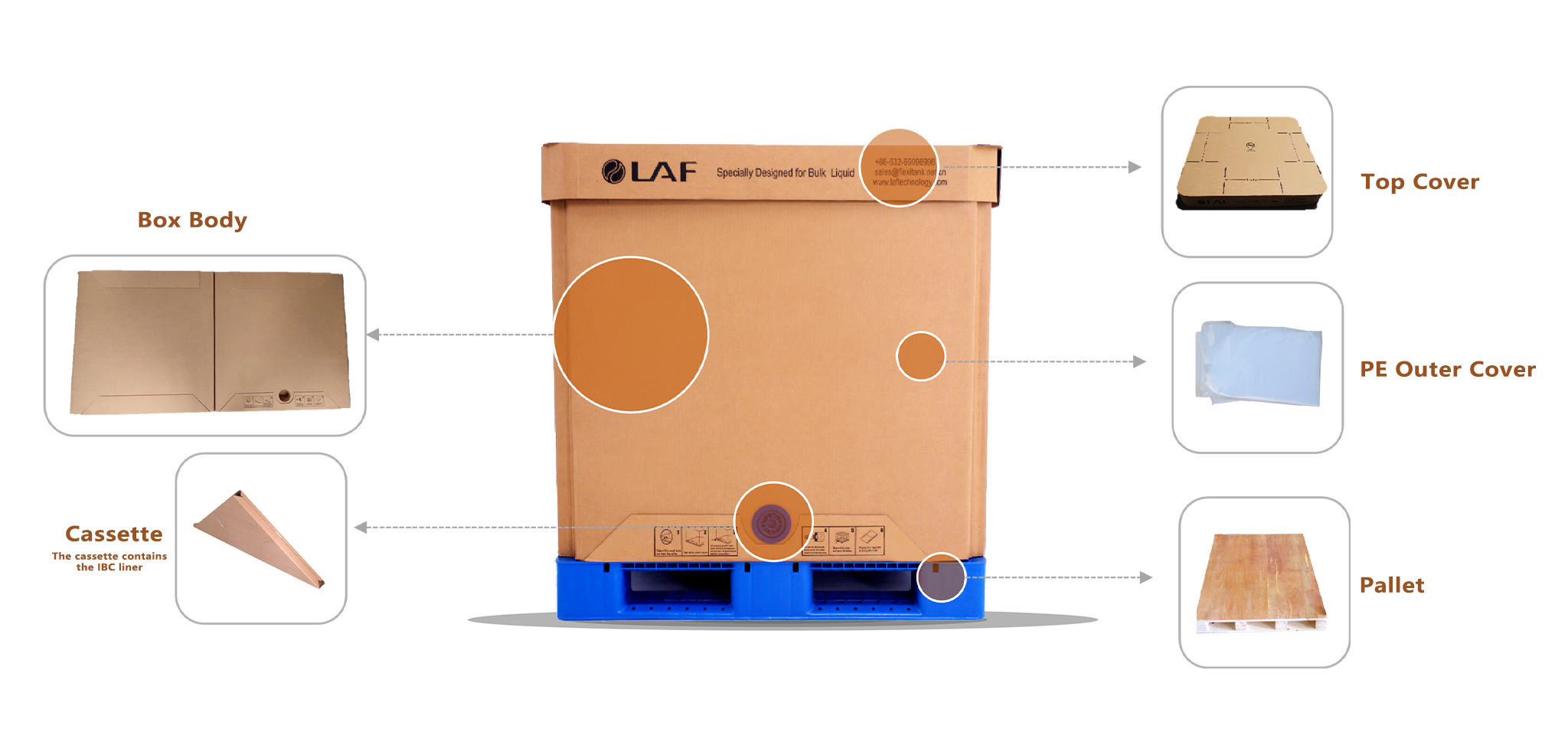
A complete LAF Paper IBC system consists of several components working together.
Box Body
The main structural component, manufactured using high-strength paper materials.
Cassette
The cassette contains the IBC liner, with an electric heating pad available as an optional configuration.
IBC Liner
The liner is the liquid-contact component. Available capacities range from 1,000 to 1,200 L, with cubic and pillow-shaped options. Depending on cargo requirements, liner materials can include PE, Alu-foil, EVOH, and Nylon. Irradiation sterilization is also available according to product requirements.
Top Cover & PE Outer Cover
The top cover forms part of the box structure, while the PE outer cover is applied after loading to provide dust and moisture protection.
Pallet
Wooden, plywood or plastic pallet options are available to support handling and transportation.
For temperature-sensitive products, an electric heating pad can also be configured. The available solution is CE certified and compliant with the Low Voltage Directive (LVD) and Electromagnetic Compatibility Directive (EMC).
What Liquids Can It Carry?
LAF Paper IBC is designed for selected non-hazardous bulk liquids, including applications across several industries.
Food & Beverage
Applications include:
• Juices
• Edible oils
• Syrups
• Wine
• Sauces
• Ketchup
• Sweeteners
• Soy sauce
• Dairy
Industrial Oils
Suitable applications include:
• Lubricants
• Base oils
• Glycols
• Gear oils
• Motor oil
Non-Hazardous Chemicals
Potential applications include:
• Emulsions
• Essences
• Plant extracts
• Nutrient liquids
• Cosmetics
• Adhesives
Cargo compatibility should be evaluated according to the specific product and liner requirements.
How Is It Different From Drums and Rigid IBCs?
The difference is not simply the material used to make the container. It is the way the packaging fits into the overall logistics process.
For liquid volumes that would require multiple drums, a Paper IBC can consolidate the cargo into a single bulk packaging unit. Paper IBCs can hold up to 20% more liquid per unit of space than round barrels, helping increase packaging efficiency.
Storage is another consideration. Because the Paper IBC is collapsible, it can occupy significantly less space when empty. When storing the same liquid volume, collapsible Paper IBCs occupy approximately one-third of the space required by round barrels or rigid IBC totes.
The single-use format also changes what happens after delivery. Rather than planning for empty-container return and cleaning, the Paper IBC is designed as a one-way packaging solution and is 100% recyclable.
What Are the Key Benefits?
1. High-Strength Structure
LAF Paper IBC uses a continuous-winding process and bionic laminated structure to create a seamless, integrated box body. The Easy-Form process is designed to distribute stress more evenly around the corners, while Steel-Like Technology uses cross-layer stacking to improve isotropic strength and structural integrity.
2. Tested for Transport
LAF Paper IBC has undergone testing according to ISTA 3E, including rotational edge drop, inclined impact, compression, and random vibration tests. Designed to withstand the demands of real-world transportation.
3. Efficient Handling and Storage
Its collapsible design can help reduce the space required for empty packaging. The packaging format also consolidates bulk liquid into a single unit, reducing the handling associated with multiple smaller packages.
4. Lower Logistics Requirements
For the same shipment volume, collapsible Paper IBCs can reduce 2–3 empty-container trips compared with round barrels or rigid IBCs, helping reduce freight costs and fuel consumption.
5. Recyclability and Carbon Footprint
LAF designed Paper IBC with sustainability in mind. It is 100% recyclable and has undergone carbon footprint assessment based on ISO 14067. Paper IBC can achieve 50% lower carbon emissions compared with conventional plastic IBC totes, supporting customers looking to reduce the environmental impact of their bulk liquid packaging.
When Should Shippers Consider Paper IBC?
Paper IBC can be considered when a shipper is looking for an alternative to conventional drums or rigid IBCs for non-hazardous bulk liquids.
It may be particularly relevant when the logistics requirements include:
• Moving bulk liquids in a consolidated packaging unit
• Reducing empty packaging storage space
• Simplifying handling
• Reducing empty-container return logistics
• Using a single-use packaging format
• Improving packaging recyclability
• Handling temperature-sensitive liquids with an optional heating solution
The right configuration ultimately depends on the cargo characteristics, density, compatibility, loading and discharge requirements, transportation conditions, and temperature requirements.
A Different Way to Move Bulk Liquids
Paper IBC is not simply a paper alternative to a rigid container. It is a different approach to bulk liquid packaging—combining a collapsible high-strength structure, an adaptable liner system, optional heating technology, and a recyclable single-use format.
For shippers looking to rethink how bulk liquids are packaged, handled, stored, and transported, LAF Paper IBC provides another option to consider.
Rethink Bulk Liquid Packaging. Discover LAF Paper IBC.