Introduction: Choosing the Right Food Grade Flexitank Manufacturer
Food and beverage companies around the world rely on bulk liquid transportation solutions to move products efficiently across international supply chains.
For products such as edible oils, wine, juice concentrates, syrups, and food ingredients, transportation safety is a critical consideration.
A food grade flexitank is specifically designed for transporting food-contact liquids in bulk quantities while maintaining product quality during transportation.
However, not all flexitanks are suitable for food applications.
When selecting a food grade flexitank manufacturer, buyers should evaluate:
l Food-contact material compliance
l Manufacturing quality control
l Certification systems
l Product compatibility
l Production traceability
l Global technical support
This guide explains what food-grade flexitanks are, which certifications matter, what liquids they transport, and how companies can choose a reliable supplier.
What Is a Food Grade Flexitank?
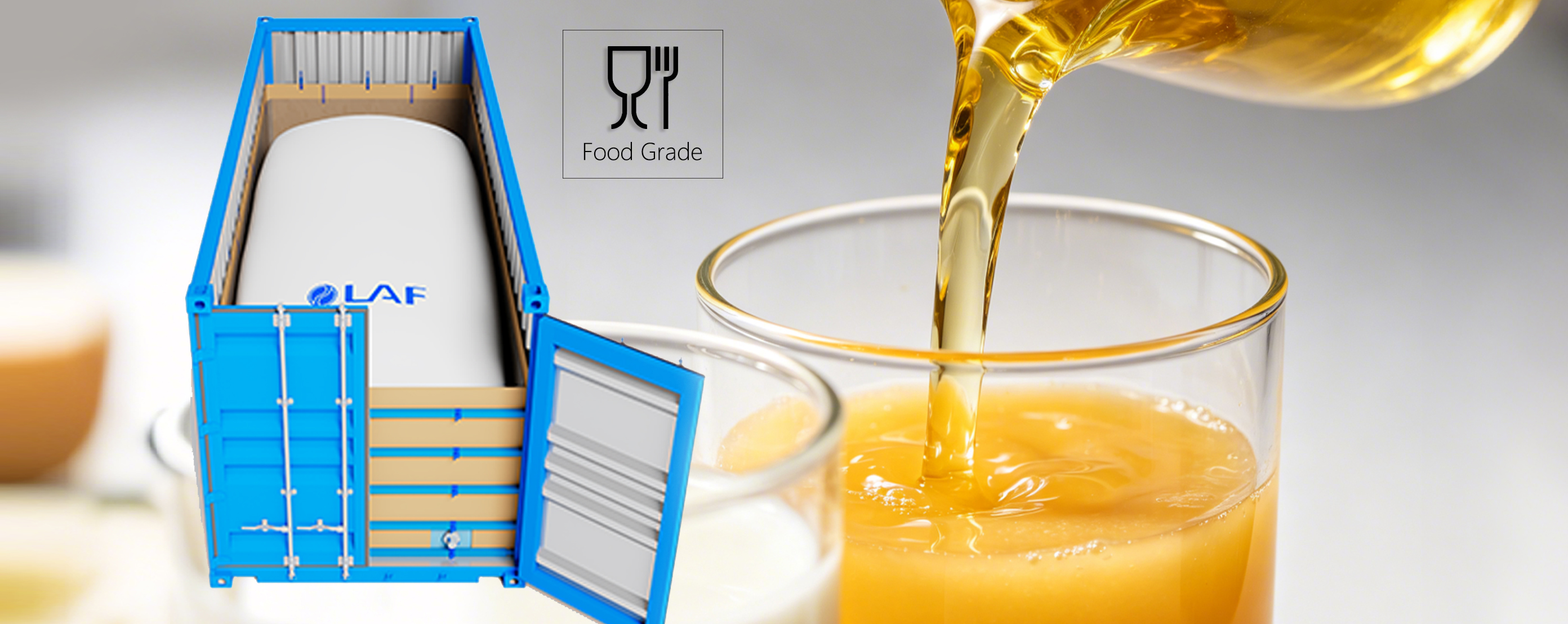
A food grade flexitank is a flexible bulk liquid container manufactured with materials designed for contact with food products.
It is installed inside a standard shipping container and allows companies to transport large volumes of liquid products through international logistics networks.
A food-grade flexitank typically includes:
l Multi-layer food-contact polyethylene film — Provides liquid containment and barrier properties
l Reinforced outer layers — Enhances structural integrity during transit
l Food-compatible valve systems — Enables controlled filling and discharge
l Protective components — Corrugated paper rolls, bulkheads
l Quality-tested sealing structures — Ensures leak-proof performance
The design focuses on:
l Product safety
l Leak prevention
l Transportation stability
l Maintaining product quality
Why Are Food Grade Flexitanks Used?
1. Efficient Bulk Transportation
Food products are often transported in large volumes across continents.
Flexitanks allow companies to ship thousands of liters of liquid products using standard containers.
Typical capacity:
l 20ft food grade flexitank: Approximately 14,000–26,000 liters
Actual capacity depends on:
l Product density
l Container specifications
l Flexitank design
2. Reduced Packaging Requirements
Compared with multiple smaller containers, flexitanks simplify bulk liquid transportation.
Potential advantages include:
l Fewer handling units
l Reduced packaging complexity
l More efficient loading operations
3. Protection of Product Quality
Food products may be sensitive to:
l Oxygen exposure
l Contamination risks
l Temperature changes
l Material compatibility issues
Professional food grade flexitank manufacturers design products according to cargo requirements.
Common Food Applications of Flexitanks
Food-grade flexitanks are widely used for:
Edible Oil Flexitanks
Common products include:
l Palm oil
l Rapeseed oil
l Vegetable oil
l Sunflower oil
l Soybean oil
Important considerations:
l Food-contact compliance
l Material compatibility
l Oxidation protection
Wine Flexitanks
Wine transportation requires careful consideration of:
l Flavor preservation
l Oxygen transmission
l Material neutrality
Professional suppliers provide wine-compatible solutions designed to minimize product quality changes.
Juice Concentrate Flexitanks
Used for:
l Fruit juice concentrates
l Beverage ingredients
l Liquid food products
Key requirements:
l Food safety compliance
l Leak prevention
l Product protection
Syrup and Liquid Food Ingredients
Flexitanks are also used for:
l Syrups
l Sweeteners
l Food additives
l Liquid ingredients
For high-viscosity products, suppliers should consider:
l Discharge performance
l Valve selection
l Residue control
What Certifications Should a Food Grade Flexitank Have?
When evaluating food grade flexitank suppliers, certifications are one of the most important factors.
1. FDA 21 CFR Food Contact Compliance
For the U.S. market, food-contact materials are evaluated according to:
FDA 21 CFR requirements
This helps demonstrate that materials are suitable for intended food-contact applications. LAF flexitanks meet FDA food-grade requirements and are manufactured with 100% virgin PE resin to ensure safety.
2. EU 10/2011 Compliance
For European markets, plastic food-contact materials are evaluated according to:
EU Regulation 10/2011
This regulation covers requirements for plastic materials intended to contact food. LAF production processes meet EU food safety regulations for plastic packaging in direct contact with food.
3. FSSC 22000 Food Safety System
FSSC 22000 is a recognized food safety management certification system.
It demonstrates that a manufacturer has established structured food safety management processes. LAF is among the earliest flexitank manufacturers in Asia to obtain FSSC 22000 certification.
4. KOSHER and HALAL Certifications
Depending on customer requirements and target markets, some food manufacturers also require:
l KOSHER certification
l HALAL certification
These certifications may be important for specific food supply chains. LAF flexitanks are certified to both Kosher and Halal standards.
5. ISO 9001 Quality Management
ISO 9001 demonstrates the implementation of quality management systems.
It is commonly considered when evaluating industrial suppliers. LAF production is carried out in accordance with ISO 9001 requirements.
How Are Food Grade Flexitanks Manufactured?
A professional food grade flexitank factory typically controls multiple production stages.
1. Material Selection
Manufacturers select materials based on:
l Food-contact requirements
l Product characteristics
l Transportation conditions
LAF uses 100% virgin new PE resin for film production, with no recycled materials added, ensuring food safety and quality consistency.
2. Film Production
The multilayer film structure is produced to provide:
l Strength
l Flexibility
l Barrier performance
3. Heat Sealing and Assembly
Manufacturing processes include:
l Film cutting
l Heat sealing
l Valve installation
l Component assembly
4. Quality Inspection
Professional manufacturers conduct testing such as:
l Film strength testing
l Seal strength testing
l Valve inspection
LAF's production is carried out in full accordance with FSSC 22000 and ISO 9001 requirements, with all materials undergoing sterilization to meet edible packaging standards.
Food Grade Flexitank Buyer Checklist
Before selecting a supplier, buyers should evaluate the following.
1. Does the Manufacturer Have Food-Grade Experience?
Ask:
l How long has the company manufactured food-grade flexitanks?
l Does it serve food and beverage customers?
l Does it understand different liquid applications?
2. Are Materials Food Contact Compliant?
Confirm:
l Food-contact documentation
l Material specifications
l Testing reports
3. Does the Supplier Have Quality Management Systems?
Evaluate:
l Production control
l Traceability
l Inspection procedures
4. Can the Supplier Provide Technical Support?
International transportation requires support including:
l Installation guidance
l Loading instructions
l Unloading recommendations
LAF Technology: Food Grade Flexitank Manufacturing Capability
LAF Technology is a professional China-based flexitank manufacturer providing food-grade bulk liquid transportation solutions.
The company supplies food-grade flexitanks for applications including:
l Edible oils
l Palm oil
l Vegetable oils
l Wine
l Juice concentrates
l Syrups
l Food ingredients
LAF's food-grade solutions are supported by certifications and quality systems including:
l FDA 21 CFR food-contact compliance
l EU 10/2011 compliance
l FSSC 22000
l KOSHER
l HALAL
l ISO 9001
LAF is among the earliest flexitank manufacturers in Asia to obtain FSSC 22000 certification, and its products are trusted by global food industry leaders including COFCO, Coca-Cola,Yihai Kerry and Cargill, Incorporated
The company integrates manufacturing processes including:
l Material processing
l Film production
l Flexitank manufacturing
l Quality testing
All production is carried out with 100% virgin new PE resin and in full accordance with FSSC 22000 and ISO 9001 requirements, ensuring consistent production quality for global customers.
Frequently Asked Questions
What is a food grade flexitank?
A food grade flexitank is a flexible bulk liquid container designed for transporting food-contact liquids such as edible oils, wine, juice, and syrups.
What liquids can be transported in food grade flexitanks?
Common applications include:
l Palm oil
l Vegetable oil
l Wine
l Juice concentrate
l Syrup
l Food ingredients
Are all flexitanks suitable for food products?
No.
Food applications require:
l Appropriate materials
l Food-contact compliance
l Manufacturing controls
Industrial flexitanks should not be used for food products unless specifically designed and approved.
What certifications should a food grade flexitank manufacturer provide?
Common certifications include:
l FDA 21 CFR compliance
l EU 10/2011 compliance
l FSSC 22000
l ISO 9001
Additional certifications such as KOSHER and HALAL may depend on market requirements.
How much can a food grade flexitank carry?
A standard 20ft food-grade flexitank usually carries approximately 14,000–26,000 liters.
The exact capacity depends on product density and transportation requirements.
Conclusion: Choosing a Reliable Food Grade Flexitank Supplier
Selecting a food grade flexitank manufacturer requires more than comparing prices.
Food and beverage companies should evaluate:
l Food-contact compliance
l Manufacturing capability
l Quality management
l Product compatibility
l Technical support
l Industry experience
A qualified supplier helps ensure that food liquids can be transported safely, efficiently, and consistently across global supply chains.
The Container Owners Association (COA) has established stringent guidelines for flexitank manufacturing, installation, and application. LAF flexitanks fully meet the COA Code of Practice for Flexitanks.
As international food trade continues to grow, reliable food grade flexitank manufacturers will play an increasingly important role in modern bulk liquid logistics.
Continue Reading
This article is part of a series on flexitank solutions and bulk liquid transportation.
Return to the overview:
➡ Article 2: Top Flexitank Manufacturers 2026: A Buyer's Guide
Continue exploring related topics:
➡ Article 1: Flexitank Buyer's Guide 2026: How to Evaluate Manufacturers and Choose the Right Supplier
➡ Article 4: What Liquids Can Be Transported in a Flexitank?
➡ Article 5: How Are Flexitanks Manufactured?
➡ Article 6: Flexitank Safety Guide
➡ Article 7: About LAF Technology
For more information:
Website: www.laftechnology.com
Email: sales@flexitank.net.cn